


Are you going to Cannes Config next week?? I’ll see you there! I’m hosting the next On Brand party with my good friends at Fuzzco on Wednesday, June 24 at Southern Pacific Brewing. We’re at waitlist already, but you should still sign up and drop me a note so I can get you in.


And if 7:30pm is past your bedtime, I’m also hosting a we’re-not-at-Cannes post-Config happy hour with the excellent team at Capsule. It’ll be at Amelie on Polk, where you can share a glass of wine and a lump of smelly cheese with a fellow marketing or design leader. RSVP if you’d like in!
(Side note: Is it just me, or is your LinkedIn feed also swarmed by B2B marketers attending Cannes? And if everyone in tech is going now, does that mean it’s not cool anymore? 😛)
If someone sent you this post and you’re not subscribed, join those people learning how to tactically advocate for brand at your company. 📬
“So, you’re more brand than demand gen, right?”
I’ve had some version of this said to me in almost every senior marketing interview. A recruiter, a hiring manager, a founder, whoever—who has decided those are the two (very separate) buckets that everything goes in. (Nevermind the forgotten stepchild, product marketing.)
I’ll tell you what I was doing in those years they’re categorizing as “brand”: at Brex, building integrated media campaigns that introduced the product to hundreds of thousands of people who’d never heard of it. At Notion, running out-of-home across a dozen cities to move a market that didn’t know it needed a new way to work. At Gusto, launching the company’s first-ever brand campaign with Kristen Schaal to show businesses something way better existed. Not brand as a design sub-function (working with design to create the visual identity was part of the job, but not all of it). Not brand as a service org briefed to make ads look nice. Creating demand where none existed.
By definition, that’s demand generation.
So what is demand gen, exactly? If we google it, here’s what comes back: “The umbrella term for top-of-funnel marketing activities aimed at creating long-term brand awareness and warming up leads before they are ready to buy.” That’s a brand marketing definition. The same search tells you demand gen channels are search, retargeting, ABM, performance social, lifecycle. Those don’t create awareness. They capture it. They find the people who already know who you are and provide an opportunity for that familiarity to turn into a conversion.
Like many terms in marketing, the term “demand gen” has been badly misused. And because nobody stopped to fix it, the entire SaaS marketing industry built its org structures, its hiring categories, its agency specializations, and its budget debates on a definition that means something different to everyone in the room (I’m not the only one confused—just ask Reddit).


Said with love, the people who force us into a lane are not usually the people in the weeds doing the work: Recruiters sorting profiles into buckets; founders who’ve decided marketing means pipeline and brand is overhead; finance teams comparing CPL across channels where one channel doesn’t generate a trackable lead. All of us have absorbed a broken definition and made it structural. Except practitioners actually running integrated campaigns know that line doesn’t hold.
If demand generation means what it says—generating demand, creating desire for your product in people who didn’t have it before—then the function doing that work is brand marketing. OOH introduces your product to a market that’s never heard of it. Events create emotional connection and fodder for WOM sharing. Content reshapes how a category is understood. Campaigns put your name in the right place in someone’s consideration set before they know they need you. That is literally demand being generated.
Search, retargeting, ABM, performance social, etc. are channels that find people where demand already exists and capture it. They’re great at that job. But they’re not pure demand generation. They’re demand capture. Very likely, some intent was already there when they showed up.
Somewhere along the way the industry renamed the capture function “demand gen.” Probably because “capturing demand” sounds passive and “generating demand” sounds like growth. 🙃 But syntax has consequences. It made brand marketing look like something softer, upstream, adjacent to the real work. Something you do before marketing actually starts. AND I HATE THAT FOR US!
Most conversions are only possible because someone did the upstream work. The branded search query that closed at near-zero CAC—somebody put that keyword in the customer’s head. The retargeted ad that got the click—why were they worth retargeting? Brand marketing did that. The capture channel got the credit. This is why the brand vs. demand budget debate never goes anywhere. The attribution model runs on last touch, and last touch rewards the channel present at the moment of conversion, not the chain of exposures that made it possible.
(I wrote about this in “How to Explain Brand to Finance”: the math companies actually use doesn’t credit the work that created the demand. So brand defends itself every quarter with metrics that don’t show up in the dashboard its work built.)

When you organize teams around a broken definition, you get dysfunction. With brand, that often looks like either:
Brand more or less reports into demand/gets the budget leftovers from growth marketing: brand becomes a service org. The team gets briefed after strategy is set. They make the ads look good, write the copy, execute what the demand team decided it needed. They’re not in the room for the questions that shape the brand—what should we be known for, to whom, and why now. So brand drifts into whatever performs best this week. CAC creeps up. The brand loses shape, and people start to shape it for you.
Or, brand reports into design, fully detached from marketing: the team gets very good at visual identity, type systems, photography direction. But they’re not in the room when the question is which segments to move against this quarter, or what messaging will land with them. Brand’s just seen as who’s pushing back on asks to make the logo bigger while campaign and flighting decisions happen elsewhere. The brand looks consistent visually, but strategically, your story is all over the place.
Both structures make the same mistake. If brand marketing is the demand generation function (which it is), it can’t report into demand capture. It has to sit alongside it, planning at the same time, on the same calendar.
How to fix this? Sequence your channels!!
Once you accept that brand generates demand and capture channels convert it, the planning model designs itself. You can stop treating them like two separate workstreams competing for budget. They’re both part of one campaign with two jobs, running in sequence.
I’ve referenced this rough flighting model (first shared with me by Dani McDonald, who succeeded me as Brand Director at Brex ☺️) for years as a way to visualize about this:
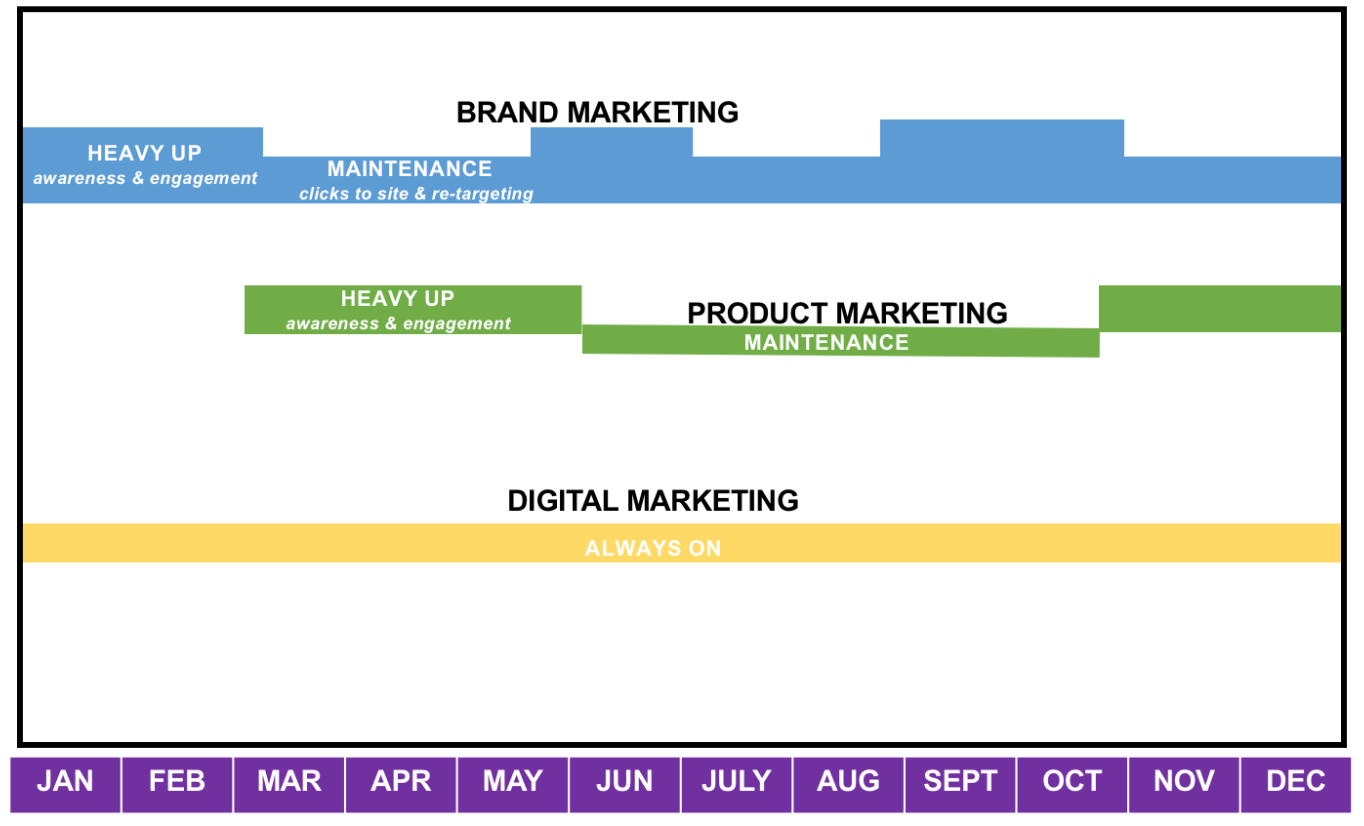
Brand marketing should run in heavy-up periods: integrated campaigns, OOH, experiential, events, big creative pushes concentrated around the moments you’re trying to move a market or own a season. Between heavy-ups, brand stays on at a maintenance level. Lower spend, always present, driving site traffic and keeping the brand visible.
Demand capture is always on. Search, ABM, lifecycle, performance social, retargeting. Its job is to convert the intent that brand generated—organic and paid. BUT, the key is that capture should also be coordinated with the wave brand just created, not with totally separate creative and messaging. A brand heavy-up creates a surge of new awareness. The capture layer needs to lean into that surge for weeks and months after the campaign ends, not just during.
Product marketing layers in around launches and category moves, heavy around those moments and at maintenance the rest of the year. (That’s why early-stage companies often look heavier on product marketing—they’re just getting started, launches happen every few weeks. As you grow, you won’t have as rapid product/feature news to share—you’ll need to manufacture another reason for people to pay attention.)
Intentional sequencing works because it mirrors the actual customer journey. Brand warms up the room. Capture works the room and closes. A retargeted ad served to someone who saw your billboard last week costs less to convert than a cold impression served to someone who’s never heard of you. Brand creates awareness and also reduces the price of every conversion that follows.
At Notion, this is what integrated campaigns actually looked like. Out-of-home and brand media drove the awareness spike—billboards, transit, social, influencer, experiential. In the same window, Google, Meta, and search retargeting were set up to capture the awareness the OOH was creating, using the same creative system, geo-targeted to the OOH footprint. If you saw a Notion billboard in San Francisco on Monday, you got a Notion ad on Instagram on Wednesday that picked up where the billboard left off.
We measured across geos: markets with brand activations versus markets without, with demand spend held constant. Markets with the brand layer drove a ~20% awareness lift in core segments and a corresponding lift in signups and site traffic that showed up weeks after the OOH came down. The brand spike created demand. The capture engine converted it thanks to being on the same brief, same calendar, same dashboard.
To conclude my existential crisis…
I’m done nodding when someone guesses I’m “more brand than demand gen.”
Because if demand generation means what it says (and I think it should), I’ve been generating demand my entire career. So have most of the brand marketers I know. We built the associations that made products worth choosing, generated the interest that search and retargeting later converted and claimed credit for. Someone else just named the function.
That's what happens inside a broken definition long enough: everyone accepts the limits it places on them. Marketers settle into lanes. Agencies pick sides. Leaders hire for people who’ve “run the playbook before,” never pausing to ask if the playbook is describing the right job.
Which means the companies that say they don’t invest in brand are almost certainly wrong. They’re investing in brand. They’re just doing it more or less accidentally, without a strategic frame, wondering why their CAC keeps climbing and their story is confusing.
You can’t not do brand work. Every campaign builds brand equity and cohesion, or fragments it. The only question is whether you’re doing it on purpose.
So: are you brand or demand gen?
Both. You’ve always been both. 👊🏼
P.S. If you’re a demand gen marketer reading this…
…and want to deepen your definition of brand, you might like How to Explain Brand to Finance and How Do You Measure Brand?
Thanks for reading.
How does your org define brand and demand gen? Have you gotten it figured out?
And if this was helpful, consider:
replying and saying hi!
connecting with me (Kira Klaas 👩🏼💻) on LinkedIn with a note
taking the 2-minute reader survey ‼️
sending to a friend 💌 or coworker 💬
The intentional sequencing point is super useful! Brand and capture need to sit on the same calendar, not in separate conversations. But ultimately, the org chart decides whether that can actually happen.
Once “demand gen” means capture, the company starts rewarding the moment of conversion instead of the conditions that made conversion possible. Less brand vs. demand, more whether the organization is designed to create, shape, and capture demand as one system.
Nodding along to this entire piece. I was in a conversation about this exact thing with a client this week. A team standing up a separate "demand gen" tier walled off from brand, with brand essentially being shoved to the side for "when we have extra budget." It's a little wild to see the dysfunction you're naming play out in real time. The capture channel gets called "demand gen," brand gets quietly filed under overhead, and everyone wonders why CAC keeps climbing. Thank you for naming this!