


A few weeks ago I stepped back into full-time operating. 👩🏼💻 If you missed my LinkedIn post (are we friends there?), I’m joining Later as VP, Corporate Marketing and stepping into the world of social & influencer marketing. So today’s post is timely as I get up to speed on what’s been happening there—I’ve been delightfully offline for the better part of last year on an epic “corporate gap year,” traveling full-time with my husband across 20 countries. Outside of work, we both love writing, food, and travel—so if that sounds up your alley, subscribe to Sabbatique. 🫒
I spent the better part of last week at Brandweek, enjoying the perpetual dry sauna that is Phoenix. 🧖🏼♀️ Other than the 107°F weather, my favorite part was meeting everyone. You’ll see some highlights sprinkled throughout upcoming posts!
You’re here because you recently subscribed or signed up for one of my resources—my course waitlist on Maven, lightning lesson, or Notion templates.
If someone sent you this post and you’re not subscribed, join those people learning how to tactically advocate for brand at your company. 📬
Over the past few years, we’ve seen a surge in “unhinged” marketing—brands adopting outlandish, bizarre, and irreverent (even borderline inappropriate? 💀) approaches to capture our ever-divided attention. Such content has at times felt fresh and surprising, and at others, confusing and cringeworthy.
As a constant observer of marketing trends (and a fan of some unhinged content in my personal life—ever heard of YTP?), I’ve found myself fascinated by this trend, but have taken a wary eye towards “unhinged” tactics in professional settings. Why is that? Do I not believe in the ROI? Do I view such tactics as consumer-only? Am I using my millennial brain instead of deeply understanding what resonates with younger generations?
Digiday describes unhinged marketing as “leaning into the language of the internet to appear relatable and human-like” (lol) and “using shock value to drum up engagement and go viral.” First off, if you’re building a strategy around seeming “human-like” you probably have deeper problems to address. And secondly, are these goals and tactics really so new?
At first I thought the answer was yes, this is a new(er) trend that matches the Gen Z zeitgeist. But after researching for this post, I now feel the opposite—unhinged is a flavor of guerrilla marketing tactics that have long had a place in corporate marketing playbooks. (Both guerrilla and unhinged both use questionable/problematic verbiage that I don’t love, but that’s another topic.)
Guerrilla marketing is characterized as a type of advertising that uses unconventional tactics to promote a product or service. It’s often low budget and focused on the element of surprise to create word of mouth, the modern equivalent being social media virality (although—there’s an argument to be made that offline word of mouth, person-to-person dialogue, is still much higher value than social media virality, views and likes—essentially vanity metrics with low correlation to ROI).
Remember the Oscar Meyer Weinermobile, a giant hot dog on wheels that drove around the country as early as the 1930s? How about the Energizer bunny, who started as a TV mascot but soon started making public appearances, vaulting into an icon of the era? These are great examples of proto-guerrilla marketing.

More recent (but still old…) examples inch closer to the modern unhinged form: take a watch of Quiznos’ “Any coupon works” campaign (sorry in advance). This is 17 years old! It’s one of the first references to a viral meme that I’ve found in corporate marketing. And that’s the big difference in unhinged vs. “traditional” guerrilla marketing—the content is highly influenced, derived from, and aiming to perpetuate internet meme culture. Brands saw the power of virality in the 2010s and have been chasing that dragon ever since.
But as behaviors (and algorithms) have shifted, it’s important to remember: Virality does not equal profitability. You may have millions of Gen Z and now Gen Alpha kids watching your content online, but is it converting? Attention is currency in the modern economy, but…cash is king. Teams should never be setting a goal of “going viral”—it’s simply not predictable or controllable (and in 2024, there are widely varying degrees of virality one can achieve). You should make room for experimentation, but goals should still be based around outcomes—increased awareness, ROI, etc.
And, social isn’t the only channel—TV spots, merch and collabs, experiential marketing are all important and candidates for less traditional approaches. Does unhinged translate cross-channel? Nutter Butter—today’s unlikely prom king of “unhinged” marketing—hasn’t changed its packaging or physical distribution strategy. They haven’t popped up new billboards with a bare foot slathered in peanut butter (🔇 mute before opening) on the 101. Why not?
A Reddit commenter referred to “Unhinged Marketing” having its own name as “the Gen Z-ificiation of [marketing] terms” and I agree to some extent. They wrote, “This is a pillar of brand management: find a concept that resonates with a community and engage them on it.” Exactly. Guerrilla marketing is nothing new. Using surprise and cultural references isn’t either. Developing campaigns that speak to your target audience (and are differentiated) is a big part of what brand teams do.
So why is “being unhinged” working? Is it working? Is it something new and special, or the manifestation of guerrilla marketing on the memefied internet?
In this post, I break down the rise of unhinged, the shift to memes by corporate brands, and ask: How can teams be strategic with these tactics? When does unhinged veer into cringe? What can we learn from this trend, and what might we expect in the future?
Why brands are losing their minds (on purpose)
All brands operate in an attention economy, especially in highly-commodified industries like fast food, banking, mobile games, and fashion. (It’s still true in B2B, but not nearly to the same degree, which is one reason you see fewer examples here.)
Attention wars are the reason you’re seeing marketing that covers the entire unhinged spectrum, from the innocuous Big Cheez-It® Crunchwrap Supreme® to Nutter Butter’s deep-fried Instagram/TikTok feeds. In our oversaturated digital landscape, especially on social media where brands also compete with user generated content (unlike with billboards or TV), being outrageous is one of the few ways left to stand out. As Substack user Jaskaran commented on Rachel Karten’s Nutter Butter social media breakdown, “we are officially in brainrot war edition of brand social.” So true.
But there are other reasons:
Social media amplification & virality potential: Extreme content gets shared, period. In this case, the unhinged content is extreme in comparison to a generation of corporate polish and rounded standardized illustrations.
Appealing to younger audiences: Internet-native generations respond well to less polished content because it’s what they grew up with (prepare yourself, memes ahead).
Startup influence: Tech startups normalized casual and sometimes irreverent brand voices. There was a time when Slack was disrupting tech/B2B Twitter by just sounding normal. (Btw, look at them now—post Salesforce merger, their social is squarely in “boring corporate territory” again, and they’re losing ground to Discord, who’s taking an alternative approach).
Cultural shifts: We need multiple bullets here:
What was once “unprofessional” is now often seen as relatable. Too professional or too formal, and the capitalist, corporate nature of the content becomes the lasting message—not relatable, not relevant; even cringe.
Communication norms differ dramatically between generations and even micro-generations: 16- and 19-year-olds literally think text messaging is for “formal” use cases, like talking to their parents, and they only talk to their friends through Snap (based on anecdotal evidence of me talking to three of them this summer).
From another commenter, William Abramson, “Brands are recognizing and acting on our desperate need for more play in a culture of hyperoptimization and burnout.” Whether brands, or just social media managers, are conscious of this or not (at a corporate level, most of them are contributing to it), there’s definitely cultural appetite for antidotes to the business casual corporate grind we (at least as Gen X and Millennials) grew up seeing in the 80s and 90s.
This has all been coming for a while. Internet culture, and especially meme culture, directly paved the way for the rise of unhinged marketing.
Let’s pop up a quick timeline—the evolution of memes to marketing:
Early Meme Culture (late 1990s–early 2000s):
Characterized by simple image macros and repetitive jokes (think “All Your Base Are Belong to Us”)
Spread through forums and early social platforms like MySpace
Brands were largely absent from this space
The Rise of Social Media Memes (late 2000s–early 2010s):
Platforms like Facebook and Twitter became hubs for meme sharing
Memes became more sophisticated, more often referencing current events and pop culture
Some forward-thinking brands began to experiment with meme-like content (e.g., Old Spice’s “The Man Your Man Could Smell Like” campaign in 2010)
Memes Go Mainstream (mid 2010s–present):
Memes become a primary form of online communication and cultural commentary
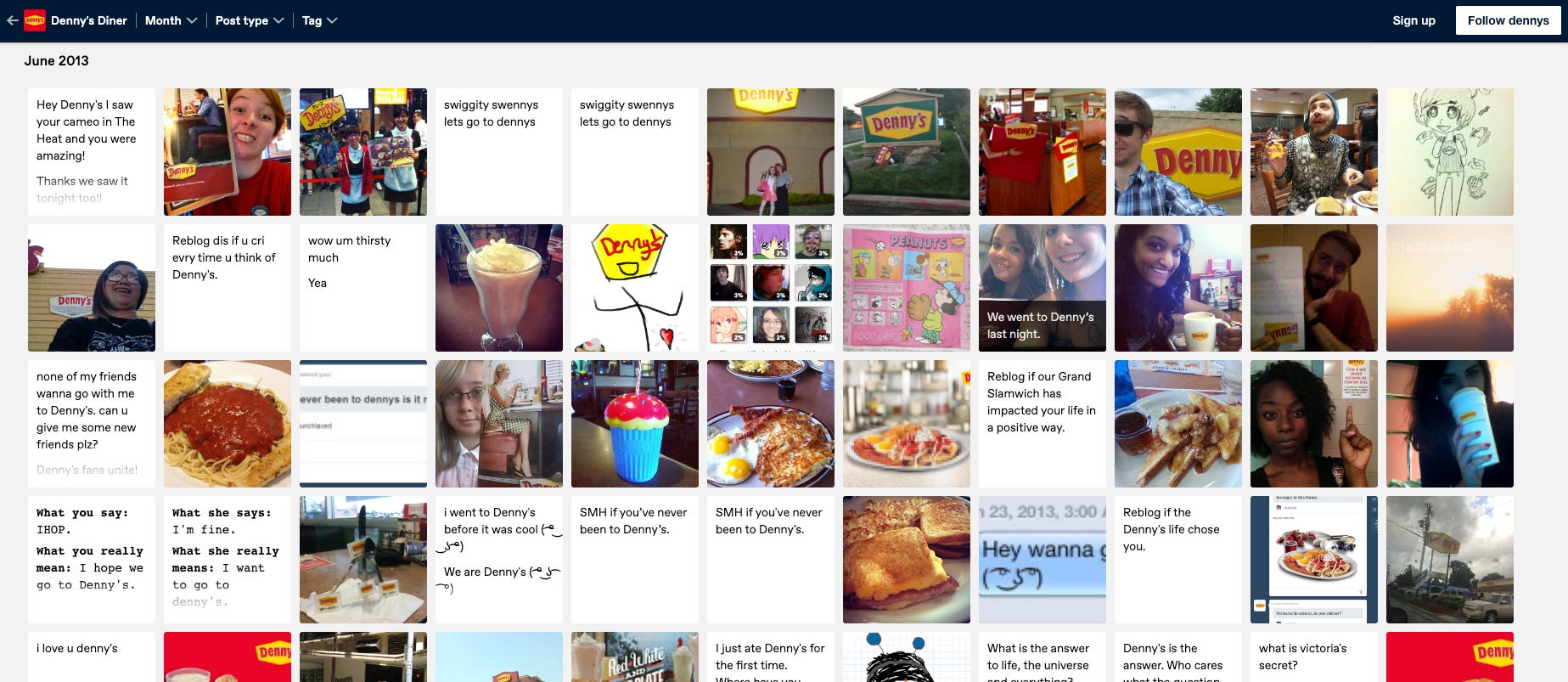
Brands start actively participating in meme culture (e.g., Denny’s surreal Tumblr presence starting around 2013—honestly this archive is…wow); brands design content specifically to spawn and inspire memes (see “Hot Line Bling” and the entire brat movement)
The line between meme and marketing begins to blur
Denny’s
You can really see where the shift to “unhinged” in corporate marketing started—it goes nearly 20 years years back to that Quiznos campaign (really worth a quick watch—here’s the history of the meme), but formalized on Denny’s Tumblr.

So what were marketers learning over these years from meme content?
For one, rapid response: Memes taught brands the value of quick, reactive content. Just as memes respond to current events in real-time, brands learned to create timely, relevant content (e.g. Oreo’s “You can still dunk in the dark” Super Bowl blackout tweet in 2013). Last week at Brandweek, Coors Light presented their “Lights Out” case study, a whole campaign and limited can release that followed Shohei Ohtani inadvertently damaging a Coors Light billboard during a game. ◼️
For another, marketers learned to embrace absurdism. Meme culture revels in the nonsensical and absurd, priming audiences to accept and enjoy similarly “random” content from brands (like MoonPie’s bizarre but therefore entertaining Twitter presence).

Hamburger Helper
Unhinged marketing might’ve peaked in 2016 when Hamburger Helper dropped a rap album: Watch the Stove. (Reddit loved it.) This was not the equivalent of a posting another Moo Deng meme, e.g. mindless trend-following—it was way unconventional for a General Mills brand, it created “something of value” for their audience, and it struck the right degree of effort-without-being-too-polished (they dropped 5 tracks on Soundcloud with high-quality production value and lyrics, and didn’t even have AI to produce it for them).

Memes also fuel inside jokes, and inside jokes = community-building, a holy grail for many consumer brands. Memes rely on shared knowledge to be understood (see: all the Aidans on Nutter Butter content). Brands have adopted this approach to create a sense of community and exclusivity among their followers (e.g., Wendy’s Twitter roasts or Steak-Umm’s “tweetstorm rants…[on] scientific literacy, critical thinking, memes, cognitive biases, woke brands, polarization, conspiracy theories, and more.” (Wut.)

Memes have also contributed to changes in written and visual communication, for better or for worse. Proper grammar now has a specific connotation in social media (periods mean you’re mad, in case you were living under a rock).

Importantly, memes also led the way for the democratization of content creation. Meme culture is equitable; anyone can create viral content. (Side note: Influencer marketing is also shifting this way as follower count becomes less of a sure signal of performance.) As meme lords took over the internet, so emboldened brand marketers took more risks and became less polished in their approach.
Unhinged marketing as a response to uncertainty
Of course, at a high level, uncertainty is an inherent part of the human experience and marketers are always operating under some degree of it. But after a decade of relative economic stability and growth (what VCs love to call the ZIRP era) where online conversion engines were more predictable than they are today, for many people, the post-Covid era is anything but certain. We’re seeing trends in higher consumer spending and lower savings, because who knows what tomorrow will bring. We’re seeing people hold off on having children due to uncertain social and climate impacts. And we’re seeing marketers trying new ideas that they may not personally resonate with in an effort to find what works in a landscape that’s changing disorientingly fast.
To me, unhinged marketing feels like a direct response to cultural and societal uncertainty.
Economic pressure drives innovation: Economic pressures especially can lead to more creative and risky (…or desperate) marketing strategies. Brands are businesses, and while you might feel like they’re increasingly focused on entertaining you and being relatable, their bottom lines are still the primary motivation. This can be a good thing. With reduced budgets, marketers are forced to think outside the box. For instance, during the 2020 pandemic, KFC quickly pivoted to create a “finger-lickin’ good” dating-sim game, reaching gamers stuck at home. Weird, but interesting and strategic enough. Was there positive ROI? I’m not sure, but at minimum they learned from a bold experiment, which cannot be underrated in large corporations.
Disruption of normal patterns: The pandemic disrupted established norms, creating opportunities for brands to redefine themselves and giving us an even more globalized shared language to joke about unprecedented times and remote work.
Going against the grain: When many brands revert to safe messaging during crises (“During these unprecedented times…”), those willing to take creative risks can capture attention. Oatly’s purposefully bad Super Bowl ad in 2021 got people talking because it wasn’t the same corporate dreck we’ve seen so many times.
Uncertainty breeds both irony and self-awareness, which have fueled meme culture and unhinged tactics, especially in the area of self-deprecating humor, which has traditionally been anathama to corporate brands seeking to project confidence and trustworthiness. Irony especially has a dark side on the internet, and brands have been surprisingly comfortable putting it on full display.
Ryanair
Brands have tapped into self awareness, often poking fun at themselves or their industry, and Ryanair is known for their approach. The budget airline’s self-deprecating TikToks mock both themselves and their customers. They also bring other brands into it.
Scrub Daddy
This sponge dominates meme culture and has leaned waaaay in to irony and shock value. They have their run-of-the-mill “internet-native content,” and then they have posts like this (NSFW 💀).
Duolingo
Everyone on Substack and LinkedIn has already sounded off on Duolingo, the poster-owl of unhinged marketing. What could be more ironic than a cute mascot going fully unhinged? If your mascot isn’t twerking and getting arrested, are you even relevant? If that’s now the bar, how do they outdo themselves? Social media trends don’t stay fresh forever. Taking things a notch higher, they’re breaking out of social—Duo is now out here spamming review sites.
When unhinged becomes cringe: A fine line
Context is everything. The unhinged strategy doesn’t work in every channel, and it certainly doesn’t work for everybody. Brand strategist @shwinnebegobrand recently warned brands off from attempting the same strategy as Nutter Butter, pointing out that the reason it’s working for them (and brands like Chili’s, Celestial Seasonings, etc.) is that they are a 50-year-old legacy brand that has both high awareness (mental availability) and very strong distribution (physical availability). As Ashwinn (the aforementioned strategist) says in the post, “If that’s not true for you, it’s unlikely to work.”
Trying too hard to be edgy, misreading the room, overusing the same tactics (see: demure trend), crossing ethical lines (see: Elon Musk’s entire personal brand), alienating core customers, or just lacking substance behind the gimmicks will result in missteps. There is nothing more cringe than being late to the game with a watered-down attempt, especially if it has “hi, fellow kids” overtones (see the other brands in Mondelez’ portfolio, like BelVita). Piling on helps amplify trends, but the value accrues to the best executions, which often inspire confused laughter, rather than discomfort. Watch that Scrub Daddy video again—it’s super uncomfortable, but funny and definitely unique.
If you’re a marketing leader or brand operator, resist the temptation to be unhinged for its own sake. Explore how it fits (or not) in your strategy, then make an informed decision with clear success criteria. Unhinged content may work for you, but avoid cringe at all costs! ⚠️ How?
Brands that are too corporate, who are not participating whatsoever in this modern discourse are the most cringe, the least self-aware, the most out of touch: The ones who don’t even pretend that they aren’t capitalist corporations doing anything they can to keep making money and paying their execs ungodly salaries.
The line often comes down to who’s on your team and who’s signing off. Older executives who aren’t in touch with modern internet culture should not be giving notes on unhinged content (very hard to avoid, because who doesn’t want to seem modern and cool). A 43-year-old tech founder who’s been rich for 10 years already or a 67-year-old marketing leader who’s been at the large CPG conglomerate for 40 years probably aren’t the ones who are going to come up with the campaign concepts that will hit with 19-year-olds (though, to be fair, they might be—great ideas come from anywhere). Those leaders are much more likely to deliver the corporate (read: cringe) content they grew up with and force their marketing teams to ship it to boost their own ego.
Trust your team, and lay out strategic guidelines and outcome goals, and empower less experienced, younger folks who sit closer to the zeitgeist to iterate. (And, just because someone is young, it does not mean they’re close to the culture—this is a specific skill that takes time and practice that you need to look for when hiring and nurturing your team.)
Is being unhinged right for you? Talk to your brand strategist today.
Before you decide to go off the deep end with your marketing, this is what I’d consider:
Your audience (who you care about today and who you want to reach tomorrow): Will they appreciate this approach, or will it alienate them?
Your brand values: Does this, at least in some way, shape, or form, align with who you are as a company? Is it “authentic”? 😅
Your industry: Some sectors have less room for playfulness than others. But that doesn’t mean your brand has to be dull. See Gusto and Lemonade and Tia.
Your long-term strategy: Can you sustain this approach, or is it a one-off stunt?
While unhinged marketing can be incredibly effective when done well, it’s not one-size-fits-all. As with any marketing strategy, the key is to build toward brand-market fit. You want to stand out, sure, but not at the cost of your brand’s integrity or your audience’s trust.
At the end of the day, good marketing—unhinged or otherwise—is about deeply empathizing with your audience. If your off-the-wall approach (or making disgusting content, lol) achieves that, you’re on the right track. If not, it might be time to rethink what you’re trying to achieve. 🧽
So are you buying Nutter Butter now?
Have a brand’s “unhinged” strategies actually convinced you to make a purchase? Or do you see through it?
If you liked what you read, consider:
saying hi or dropping a question in the comments!
connecting with me on LinkedIn: 👩🏼💻 Kira Klaas
sending to a friend 💌 or coworker 💬
Wow - amazing post. I really appreciate the historical context for meme culture and also the guidance for brands on whether to jump in or not. 👌👌👌
🦀🦀🦀